
Wedding transportation seems simple until guest count, vehicle capacity, drive time and ceremony timing collide. A hotel may be only 20 minutes from the venue, yet one shuttle can still fail to move everyone on time if loading, unloading, return travel, traffic and repeat trips are ignored.
A reliable wedding shuttle timeline solves that problem before the wedding day. It shows how many passengers need transportation, how many seats are realistically available, how long each complete shuttle cycle takes, when the final guests must arrive, and how return trips will work after the reception.
The key principle is simple: do not count seats alone. Count seats against time.
Quick Answer: How Many Wedding Shuttle Trips Do You Need?
Start with this formula:
Guests needing transportation ÷ usable shuttle capacity = minimum passenger loads
Always round up.
If 90 guests need transportation and the vehicle comfortably carries 30 passengers:
90 ÷ 30 = 3 loads
That does not automatically mean you need three separate vehicles. One shuttle might complete multiple loads when the hotel and venue are close and the transportation window is long enough. If the route is longer, two or three vehicles may be required to move those same 90 people before the ceremony.
The second calculation is therefore just as important:
Outbound drive + unloading + return drive + reloading = shuttle cycle time
Step 1: Count the Guests Who Will Actually Use the Shuttle
Your total wedding attendance is not your shuttle count.
Suppose you expect 180 guests, and 110 of them are staying at the hotel. Of those 110 hotel guests, 15 plan to drive themselves and 10 are wedding-party members with separate transportation.
Your estimated shuttle demand becomes:
110 − 15 − 10 = 85 passengers
Use RSVP transportation questions, hotel-block information and conversations with key family groups to make this number realistic. Leave some flexibility because guests sometimes change transportation plans after arriving.
Do not assume every hotel guest will use the shuttle, but do not book transportation with zero spare capacity either.
Step 2: Confirm Usable Vehicle Capacity
Ask the transportation company for the capacity of the exact vehicle you are booking. Do not rely on a generic bus category. For planning purposes, use the provider-confirmed usable capacity.
Then calculate loads:
| Guests | Usable Seats | Passenger Loads |
| 50 | 30 | 2 |
| 100 | 35 | 3 |
| 150 | 50 | 3 |
| 200 | 40 | 5 |
These are passenger loads, not necessarily the number of vehicles you must hire.
Step 3: Calculate the Full Shuttle Cycle
This is where many transportation plans break.
If the hotel is 20 minutes from the venue, the shuttle cannot necessarily depart every 20 minutes. After reaching the venue, guests must unload, the vehicle must return to the hotel, the next group must board, and only then can another departure occur.
Example:
| Stage | Time |
| Hotel to venue | 20 minutes |
| Unloading | 5 minutes |
| Return to hotel | 20 minutes |
| Reloading | 10 minutes |
| Total cycle | 55 minutes |
If 90 guests need three 30-person loads, one vehicle may need almost an hour between hotel departures. The first guests could arrive far too early while the last group risks arriving late.
Step 4: Set a Final Arrival Deadline Before the Ceremony
Never build the schedule around the ceremony start alone.
For a 5:00 PM ceremony, the target might be to have every guest at the property by 4:30 PM. The exact buffer depends on the venue, parking and drop-off area, walking distance, weather, coat check, accessibility needs, restrooms and seating process. For outdoor ceremonies, also factor in your rain plan, since a last-minute move indoors can change where guests are dropped off and seated.
At a property with indoor and outdoor wedding spaces, guests may also need time to move from the vehicle drop-off point toward the ceremony location. Plan around the actual guest arrival point and the route from unloading to the ceremony area, rather than treating the venue address as the finish line.
Step 5: Work Backward From That Deadline
Assume:
- Ceremony begins at 5:00 PM
- Final guest arrival target is 4:30 PM
- Hotel-to-venue drive is 20 minutes
- Loading requires 10 minutes
Under ideal conditions, the final vehicle would need to leave the hotel around 4:10 PM to reach the venue by 4:30, which means boarding should begin around 4:00 PM.
Example: 120 Guests and a 5:00 PM Ceremony
Assume 120 guests need transportation, each shuttle carries 40 passengers, the hotel is 15 minutes away, and everyone should arrive by 4:30 PM.
You need three passenger loads.
If one vehicle handles all three, estimate the cycle:
15 minutes outbound + 5 minutes unloading + 15 minutes return + 10 minutes loading = 45 minutes
To reach the venue by 4:30 PM, the final load must leave the hotel at 4:15 PM. Working backward 45 minutes per cycle, the second load leaves around 3:30 PM and the first load around 2:45 PM. That means the first guests arrive around 3:00 PM, two full hours before the ceremony.
With two vehicles running at the same time, the arrival window shrinks to about 45 minutes, and no guest arrives much more than an hour early.
This is why “120 guests divided by 40 seats equals three trips” is incomplete. Capacity tells you loads. Cycle time tells you whether the schedule works.
Should You Use Multiple Hotel Departure Times?
Often, yes.
Staggered departures reduce lobby congestion and give guests clear choices. With two vehicles, a schedule might list an early shuttle at 3:40 PM and a final shuttle at 4:10 PM for a 5:00 PM ceremony. With only one vehicle on a 55-minute cycle, those two departures would not be possible, because the shuttle would not be back at the hotel in time.
Use specific departure times rather than saying “shuttles begin at 3:40.”
Guests should also know that “final shuttle” means the last scheduled hotel departure. Anyone who misses it may need alternate transportation.
Plan the Return Trips Before the Wedding Day
The return schedule can be more complicated because guests do not all leave together.
Families with children may want to leave early. Older relatives may prefer transportation shortly after dinner. Other guests will stay until the final song.
Instead of providing only one end-of-night departure, consider whether staggered returns fit your guest list and budget. A reception ending at 11:00 PM might use:
- 9:30 PM: early return
- 10:15 PM: intermediate return
- 11:00 PM: main departure
- 11:20 PM: final sweep, if appropriate
Communicate the return schedule on the wedding website, hotel materials and venue signage so guests are not trying to solve transportation during the reception.
Wedding Shuttle Planning for Martinsville Gardens
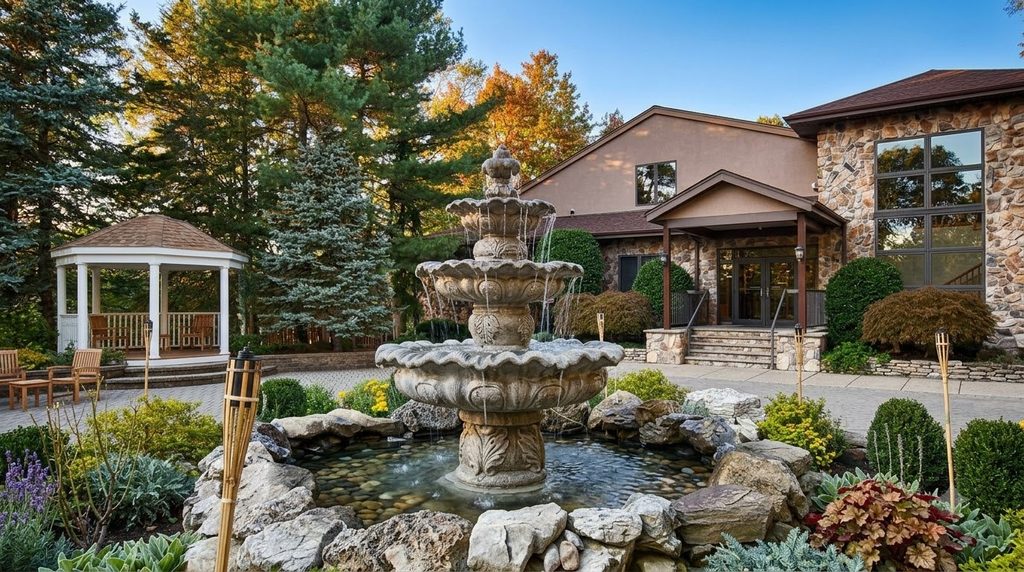
Martinsville Gardens is at 1801 Washington Valley Road in Martinsville, Bridgewater Township. The venue sits on nearly nine landscaped acres in the Watchung Mountains and includes renovated indoor and outdoor event spaces.
For a wedding there, start transportation planning by asking the venue and transportation company where buses or shuttles should enter, stage, load, unload and turn around. Confirm whether vehicle size affects access and how guests move from the drop-off area into the event. Our wedding venue tour checklist includes more questions to ask during your visit.
Because Martinsville Gardens can host the ceremony and reception on one property, couples may be able to simplify guest movement compared with weddings that use separate ceremony and reception locations. Fewer venue-to-venue transfers mean fewer transportation legs to coordinate.
If many of your guests are coming from NYC, Pennsylvania or out of state, see our guide to planning a Bridgewater NJ wedding for traveling guests for hotel blocks, train access and airport options.
Common Wedding Shuttle Timeline Mistakes
Counting seats but ignoring cycle time. Enough seats across several trips do not help when the vehicle cannot complete those trips before the ceremony.
Scheduling the final arrival too late. Guests need time to unload, walk, find seats and handle normal delays.
Forgetting loading time. Thirty guests do not board instantly. Hotel elevators, conversations, mobility needs and late arrivals all consume minutes.
Forgetting return transportation. “Shuttle provided” is incomplete information unless guests know when and where transportation returns them to the hotel.
Using the couple as transportation dispatchers. Designate a planner, coordinator, family member or transportation contact who understands the schedule.
Ignoring accessibility. Discuss accessible vehicles, boarding assistance and extra time before the wedding day.
Wedding Shuttle Timeline FAQ
How many shuttle trips do I need for a wedding?
Divide expected shuttle passengers by usable vehicle capacity and round up. Then calculate cycle time to determine whether one vehicle can make repeated trips or whether multiple vehicles are required.
Can one wedding shuttle make multiple trips?
Yes, when the hotel-to-venue distance, loading time, traffic and transportation window allow it. Short routes generally make repeat trips easier, while longer cycles can require parallel vehicles.
How early should the final shuttle reach the venue?
Early enough for guests to unload, walk to the ceremony area, use facilities if needed, and take their seats before the ceremony begins. Work backward from an arrival deadline rather than the ceremony start.
How many buses do I need for 100 guests?
Capacity determines passenger loads. A 50-seat vehicle requires two loads, while a 35-seat vehicle requires three. The number of actual buses depends on whether those loads can be completed within your available timeline.
Build the Timeline Around Time, Not Just Seats
A strong wedding shuttle timeline answers five questions: how many guests need transportation, how many passengers each vehicle can carry, how long one complete cycle takes, when the final guests must arrive, and how everyone will return after the reception.
Start with real passenger demand. Calculate minimum loads. Measure the full hotel-to-venue cycle. Establish an arrival deadline. Then test whether the planned vehicles can complete every required trip with enough margin, and confirm every pickup point before publishing guest instructions.
When the math works before the wedding, transportation disappears into the background where it belongs. Guests board, arrive with time to spare, celebrate, and know exactly how they are getting back.
Planning a wedding at Martinsville Gardens? Download our Pricing Guide or contact our team at 973-221-6450 or contact@martinsvillegardens.com to schedule a tour and walk through guest arrival with our event coordinators.