
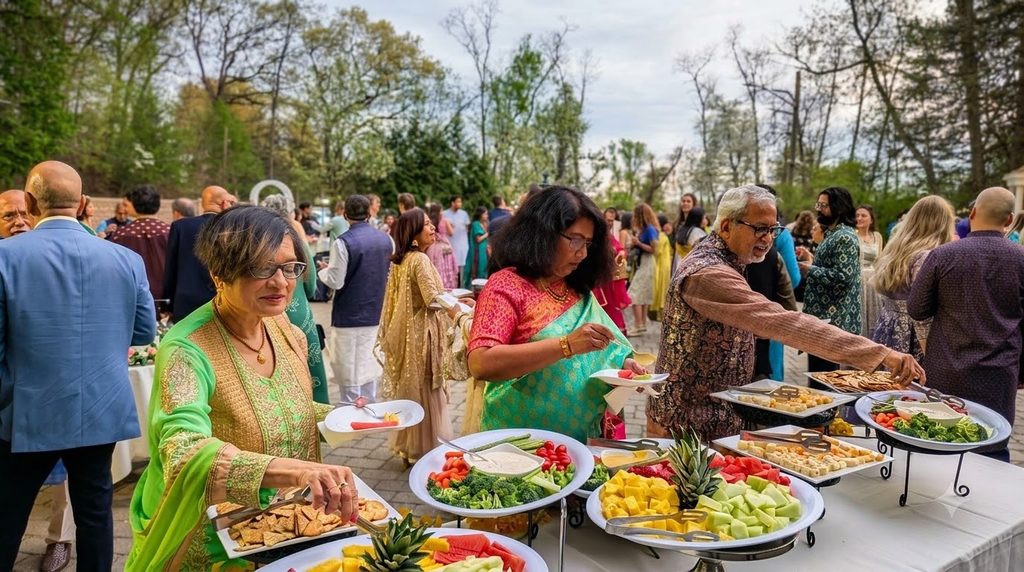
Indian-American wedding menu planning can become overwhelming. Two families may bring different food traditions, spice preferences and dietary needs. Add cocktail hour, dinner, dessert and late-night food, and the menu can quietly become two complete receptions sharing one ballroom.
A strong fusion wedding menu creates one dining experience where both culinary traditions feel intentional, recognizable and satisfying. The goal is balance, cultural meaning, guest comfort, and a service plan the culinary team can execute consistently.
Here is how to build that menu without turning abundance into duplication.
Quick Answer: How Do You Build an Indian-American Fusion Wedding Menu?
Start with courses, not cuisines.
Plan cocktail hour, dinner, dessert and late-night food first. Then decide where Indian, American and fusion dishes fit best.
A practical structure could be:
- Cocktail hour: Indian-forward small bites and playful fusion items
- Dinner: a substantial vegetarian entrée, a broadly appealing protein, another main, grain, vegetables, bread and salad
- Dessert: selected sweets from both traditions
- Late-night: casual comfort food with room for creativity
This gives both cultures presence without duplicating every course.
Start With Your Guest List Before Choosing Dishes
Before discussing samosas, paneer, chicken, steak or pasta, understand who will actually be eating.
Ask how familiar guests are with Indian cuisine, how many are vegetarian or vegan, and whether anyone requires halal food, avoids beef or pork, has allergies, follows Jain dietary requirements, or needs gluten-conscious or dairy-free choices.
Do not make assumptions based on culture. Not every Indian guest follows the same diet, and not every American guest wants a conventional Western dinner.
Identify dishes with real family significance. A few meaningful regional choices often represent a family better than ten generic buffet dishes.
Think in Courses, Not Two Separate Menus
The easiest way to control menu size is to stop designing an Indian menu and an American menu.
Instead, build one sequence:
Cocktail hour → dinner → dessert → late-night food
Then give every dish a purpose.
Cocktail hour can carry more adventurous flavors because portions are small and guests can sample freely. Dinner can be structured and balanced. Dessert can represent both families without requiring two separate displays.
If you already have an Indian chicken entrée, you do not automatically need an American chicken entrée. If paneer provides a substantial vegetarian option, you may not need a second vegetarian pasta simply for symmetry.
Use Cocktail Hour for Exploration
Cocktail hour is an ideal place to introduce Indian flavors to guests who may be less familiar with them.
Possible choices include mini samosas, paneer skewers, chicken tikka bites, chaat cups, kebabs, aloo tikki, naan-based bites, spiced sliders or small wraps.
You do not need all of them. Three or four strong options can establish the multicultural identity of the wedding immediately.
Familiar formats can also act as bridges. A slider, skewer, taco or handheld bite can make an unfamiliar flavor easier to approach without diluting its character.
The goal is not to disguise Indian food. It is to make exploration intuitive.
Build Dinner Around Roles, Not Cultural Quotas
Every dinner item should solve a real menu need. A balanced dinner might include:
- One substantial Indian vegetarian entrée
- One meat or poultry entrée with broad appeal
- One additional protein or vegetable-based main
- One rice or grain
- One vegetable
- One bread
- One salad
- Selected sauces or chutneys
Before adding another dish, ask what it contributes. Does it create a new dietary option, texture, flavor profile or cultural connection? Or does it repeat something already covered?
That question can stop menu creep before it becomes expensive and operationally difficult.
Make Vegetarian Food Part of the Main Experience
Indian cuisine gives multicultural weddings a major advantage because vegetarian dishes can be centerpieces rather than emergency substitutes.
Paneer, lentils, chickpeas, eggplant, cauliflower, spinach and mixed vegetable preparations can create a satisfying meal.
Ask one useful question:
If a vegetarian guest selected only dishes available to everyone, could that guest build a complete dinner?
If yes, the menu is doing real work. This approach can also simplify service by reducing the number of individual special meals the kitchen must produce.
Separate Spice From Heat
Couples often worry that Indian food will be too spicy for unfamiliar guests, but spice and chili heat are not the same thing.
Indian cooking can use cumin, coriander, cardamom, turmeric, fenugreek, ginger, garlic and other aromatic ingredients without making every dish intensely hot.
Build a range instead of flattening the menu. One dish might be creamy and approachable. Another can carry more heat. Chutneys or sauces can add intensity where appropriate. Labels such as mild, medium or spicy can help guests choose confidently.
Accessibility should not require stripping away flavor.
Choose the Right Service Style
Buffet, plated and family-style service can all work for an Indian-American wedding, but they create different menu opportunities.
- A buffet encourages sampling and works well with varied dietary needs, but too many dishes can create slow lines and difficult replenishment.
- A plated dinner offers control but becomes complicated with too many entrée choices.
- Family-style service encourages sharing and allows several dishes to reach each table, but table size and décor must leave enough room for serving vessels.
Choose service style before finalizing the menu because kitchen, staffing and guest-flow requirements change with the format. For a deeper comparison, see plated dinner vs buffet vs food stations for large weddings.
Use Interactive Stations Strategically
A chaat station, kebab station, dosa counter, bread station or late-night street-food concept can add energy without expanding every section of the menu. Some venues, including Martinsville Gardens, can also accommodate custom setups such as themed food trucks, which work well for late-night food.
However, interactive food requires planning. Discuss staffing, equipment, electricity, ventilation, floor space, queue management, setup time, food holding and cleanup with the venue and caterer.
One memorable station executed smoothly is more valuable than several counters that create lines and service problems.
Give Desserts Both Traditions Without Doubling Dessert
Dessert is an easy place to represent both families.
Indian sweets might include gulab jamun, rasmalai, kulfi, barfi or ladoo. These can sit beside wedding cake, pastries or another dessert meaningful to the American side. Fusion desserts can also bridge both, such as a tres leches ras malai that combines a Latin American cake with a classic Indian sweet.
Smaller portions allow guests to sample more than one item.
Consider one coordinated dessert display instead of dividing the room into “Indian” and “American” sides. The presentation should reinforce the larger idea: one wedding, two traditions, one celebration.
Coordinate the Menu With the Venue Early
A fusion menu succeeds only when the venue can support the service plan.
Martinsville Gardens in Bridgewater Township describes itself as a banquet and catering venue. In a review on the venue’s homepage, one couple shared that their wedding menu was tailored to exactly what they wanted, and that guests were raving about the Thai Chilli Garlic Noodles and Tres Leches Ras Malai.
For couples planning there, menu discussions should happen early enough to connect guest count, dietary requirements, service style, specialty stations and catering logistics. Ask what can be customized, how dietary needs are communicated, what stations require, and how food is replenished. Our wedding venue tour checklist includes more questions about how food moves from preparation to guests.
Do not design an elaborate menu first and investigate operational feasibility later. The strongest menu is one the venue and culinary team can execute consistently from the first guest served to the last.
Use the Tasting to Test the Entire Meal
Do not judge dishes only one at a time. Taste combinations.
Try the protein with the rice, paneer with the vegetables, and compare sauces. Notice repeated textures or dominant flavors.
Ask which selections hold well during large-event service, which require last-minute preparation, and how heat can be adjusted without changing the character of the dish.
A wedding tasting should test the architecture of the meal, not merely identify individual favorites.
Common Fusion Wedding Menu Mistakes
Creating two complete menus. This increases cost, waste and service complexity.
Better approach: Build one menu where every item has a purpose.
Assuming unfamiliar guests need “safe food.” Clear descriptions and varied intensity can make unfamiliar dishes approachable.
Better approach: Create accessibility without creating a second dinner.
Treating vegetarian food as secondary. Vegetarian guests deserve a complete meal.
Better approach: Include a substantial vegetarian entrée in the main menu.
Adding too many entrées. Too many choices can slow service.
Better approach: Prioritize complementary options.
Making every dish “fusion.” Not every recipe needs to combine two cuisines.
Better approach: Let the complete meal create the fusion experience.
Fusion Wedding Menu FAQ
Do we need separate Indian and American wedding menus?
Usually, no. One structured menu can represent both traditions when guest preferences, dietary needs and family traditions guide the balance.
How many entrées should we serve?
There is no universal number. Focus on whether different dietary groups can build satisfying meals without duplication.
Should Indian food be made less spicy?
Not automatically. Offer different levels of heat while preserving aromatic flavor. Clear descriptions and spice indicators can help guests choose comfortably.
Is buffet service best for an Indian-American wedding?
Buffets allow flexible combinations and portions, while plated and family-style service can also work when designed intentionally.
Should vegetarian dishes be available to everyone?
Often, yes. Making strong vegetarian dishes part of the main menu can improve variety and simplify service.
Can Martinsville Gardens cater an Indian-American fusion wedding?
Martinsville Gardens is a banquet and catering venue in Bridgewater Township that hosts cultural and multicultural weddings. One couple’s review describes a menu tailored to their wishes, with fusion dishes such as Tres Leches Ras Malai. Contact the venue team to discuss your guest list, dietary needs and menu ideas.
Serve One Wedding, Not Two Competing Menus
An Indian-American wedding menu does not need twice the food to honor two traditions.
Start with the guest list. Identify meaningful family dishes. Design by course instead of cuisine. Use cocktail hour for exploration, dinner for balance, dessert for cultural representation, and late-night food for fun. Then test the entire meal against real service conditions.
The strongest fusion wedding menu is not the one with the most dishes. It is the one where every guest can build a satisfying plate, both families recognize something meaningful, and nothing feels included simply to make the two sides numerically equal.
When those pieces align, the meal stops feeling like two buffets placed beside each other. It becomes one celebration built from two stories.
Planning an Indian-American wedding at Martinsville Gardens? Download our Pricing Guide or contact our team at 973-221-6450 or contact@martinsvillegardens.com to schedule a tour and start your menu conversation.